
Artificial intelligence has spent the last few years being treated as something that is perpetually about to happen.
It is going to transform work. It is going to change education. It is going to revolutionise healthcare. It is going to automate government. It is going to disrupt Google. It is going to eliminate jobs.
Depending on which LinkedIn post you happen to read, it is also either going to usher in a new golden age of human productivity or make most of us professionally redundant by next Thursday.
The reality, as usual, is likely to be rather less dramatic and considerably more interesting.
By 2028, I suspect we will actually be talking about AI rather less than we do today.
Not because it has gone away, or because the bubble has burst, but because AI will increasingly have become part of the furniture.
That distinction matters.
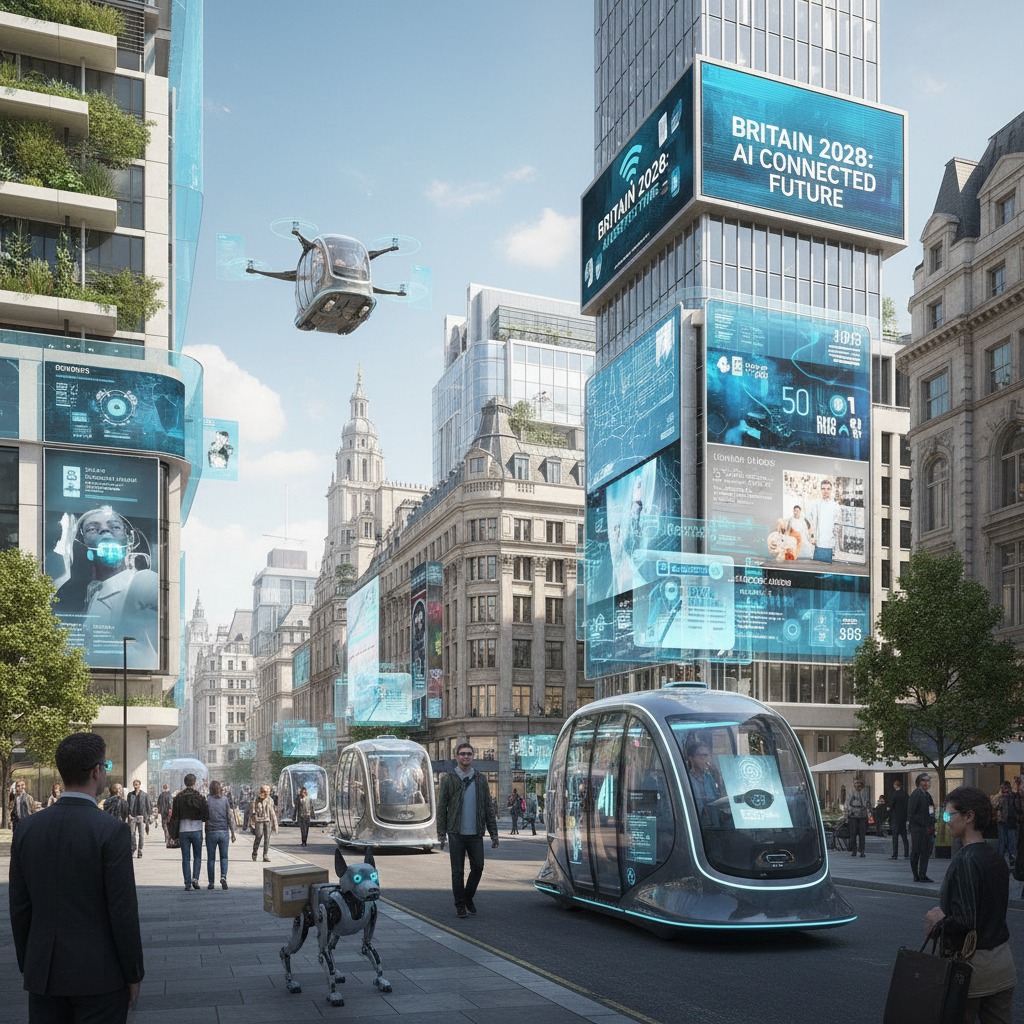
The internet eventually stopped being a separate “thing” and became a layer underneath almost every industry. Cloud computing followed much the same trajectory. Mobile did too.
AI appears to be heading in exactly the same direction.
And Britain is already rather further along that road than it sometimes feels.
According to the Office for National Statistics, 29% of UK businesses were using at least one form of AI technology by June 2026, compared with 21% a year earlier. Among businesses employing 250 people or more, adoption had reached 49%. Large language model text generation was already being used by 17% of businesses. (ONS)
Meanwhile, Ofcom reported that ChatGPT received around 1.8 billion UK visits during the first eight months of 2025, compared with 368 million during the equivalent period in 2024. AI-generated summaries were already appearing in around 30% of searches observed by Ofcom’s research. (Ofcom)
Those aren’t really numbers describing an experimental technology any more.
They describe the beginning of a fairly substantial behavioural change.
So what happens next?
My view is that Britain in 2028 won’t look particularly like science fiction. We probably won’t have humanoid robots wandering around Tesco, and your local taxi driver is unlikely to have been replaced by an autonomous Cybercab.
Instead, something simultaneously less spectacular and much more important will have happened.
AI will have disappeared into everything.
We will stop “using AI”
Today, we still consciously use AI.
We open ChatGPT. We launch Copilot. We choose an AI feature inside an application. We write a prompt. We wait for an answer.
That interaction model feels temporary.
By 2028, AI will increasingly sit between us and software.
Instead of navigating applications, menus, databases and websites ourselves, we will increasingly tell systems what we actually want to achieve.
Today, you might:
Open the CRM. Find the customer. Inspect the opportunity. Open your email. Check your calendar. Write a response. Schedule a meeting. Update the CRM.
A perfectly normal sequence of events which, when you write it down, sounds absolutely ridiculous.
By 2028, you might simply ask:
“What’s happening with the Acme account?”
And the system could answer:
“The opportunity has stalled. Sarah hasn’t responded for twelve days. Their procurement review is next Thursday. You’re both available Tuesday afternoon. I’ve drafted a follow-up and prepared the latest pricing comparison.”
Then:
“Fine. Send it and find us 30 minutes.”
This shift from applications to intentions could prove considerably more disruptive than the current chatbot boom.
Software has historically required humans to learn how machines organise information.
AI increasingly allows machines to adapt themselves to how humans communicate.
Frankly, it has taken computers long enough.
1. The British workplace becomes AI-assisted by default
The office of 2028 will probably still contain PowerPoint presentations, spreadsheets, email, meetings and people complaining about meetings.
Some things are beyond even artificial intelligence.
What will change is the amount of human effort required to produce all of them.
AI adoption is already accelerating quickly.
ONS figures show UK business adoption rising from roughly 9% in September 2023 to 29% by June 2026. Among larger organisations, it is approaching half. (ONS)
Financial services gives us some indication of where other industries may eventually end up. The Bank of England reported that 75% of surveyed UK financial firms were already using AI, with another 10% planning adoption over the following three years. (Bank of England)
By 2028, the interesting metric probably won’t be:
“Does your company use AI?”
It will be:
“How deeply does AI participate in your company’s operations?”
Because there is going to be an enormous difference between companies that have bought an AI licence for everybody and companies that have genuinely reorganised how they work around it.
Marketing teams will generate and test hundreds of variations rather than five.
Developers will increasingly supervise AI-generated implementations.
Salespeople will receive automated account research before conversations.
Finance teams will investigate anomalies conversationally.
Customer service agents will have AI analysing the customer’s history, sentiment and likely intent while the conversation is actually happening.
Managers will ask questions directly of organisational data rather than waiting three days for somebody to turn it into a PowerPoint presentation.
And a huge amount of administrative work will quietly disappear.
Meeting transcription is merely the start.
AI systems will increasingly turn meetings into actions, actions into project updates, project updates into management reports and management reports into forecasts.
The productivity gain doesn’t really come from generating a slightly nicer email.
It comes from eliminating the chain of tedious administrative work surrounding the email.
2. AI agents become digital colleagues
The next significant transition is from AI that answers questions to AI that actually does things.
We’ve started calling these systems “agents”.
I suspect we’ll eventually stop doing that, just as nobody describes a website as being “internet-enabled” any more.
It will simply become part of how software works.
An AI system won’t merely tell you how to submit an expenses claim.
It will submit it.
It won’t merely tell you which hotels meet the company travel policy.
It will compare them, check your diary, find suitable flights, prepare the itinerary and ask for approval.
It won’t explain how to change your energy tariff.
It will analyse your consumption, compare the available tariffs and prepare the switch.
That introduces something genuinely significant:
delegated computing.
For most of computing history, software has sat there patiently waiting for us to click something.
Agentic systems can operate asynchronously.
You give them objectives rather than individual instructions.
By 2028, many British knowledge workers could effectively have a small collection of digital workers operating alongside them.
One monitors customers. Another analyses competitors. Another prepares research. Another watches project deadlines. Another handles administrative tasks.
You probably won’t give them amusing names.
Actually, who am I kidding? Of course we will.
None of this requires some mythical Artificial General Intelligence to suddenly emerge from a server farm and announce that it has become sentient.
It requires sufficiently capable models, reliable integrations, sensible permission systems and organisations willing to redesign workflows around them.
Those pieces are increasingly arriving.
3. Some jobs disappear. Far more jobs change.
This is where AI predictions tend to become unnecessarily hysterical.
One camp predicts mass unemployment and the collapse of capitalism.
The other insists AI will simply create millions of exciting new jobs and everybody will live happily ever after.
Reality will almost certainly be considerably messier.
Current evidence does not show widespread AI-driven unemployment.
In March 2026, only around 5% of businesses already using AI reported that their workforce headcount had fallen because of it. (ONS)
But that doesn’t mean AI won’t affect employment.
The more interesting effect may initially be jobs that are simply never created.
Imagine a department of 100 people loses ten employees through normal attrition.
Historically, it might recruit ten replacements.
If AI allows the remaining 90 people to maintain the same output, management may recruit three.
Nobody has technically been “replaced by AI”.
There isn’t a dramatic redundancy announcement.
Nobody gets marched out of the building carrying a cardboard box while ChatGPT sits triumphantly at their desk.
But seven jobs have still disappeared.
Multiply that across thousands of businesses and the economic effect becomes significant.
The UK government’s own work on AI and employment has identified occupations with substantial exposure to AI and large language models, particularly where work involves information processing, administration and professional knowledge. (UK Government)
The vulnerable category isn’t necessarily “low-skilled work”.
That’s one of the unusual things about generative AI.
Previous automation waves disproportionately targeted repetitive physical activity.
Generative AI attacks repetitive cognitive activity.
That means junior analysts, administrators, paralegals, marketers, customer support workers, researchers, programmers, translators and finance professionals can all find parts of their jobs automated.
The important word there is parts.
Jobs are bundles of tasks.
AI doesn’t need to replace an accountant to transform accountancy.
If it automates 30% of the work performed by accountants, the economics of an accounting department changes anyway.
4. We develop a rather awkward junior-job problem
One consequence deserves much more attention than it currently gets.
Businesses traditionally create experienced workers by employing inexperienced ones.
Junior developers write relatively simple code.
Junior lawyers perform basic research.
Junior analysts build spreadsheets.
Junior marketers prepare first drafts.
Junior consultants spend an inexplicable amount of their lives moving boxes around PowerPoint slides.
Those activities aren’t simply pointless busywork.
Well, not all of them.
They are how people learn enough to become senior developers, lawyers, analysts, marketers and consultants.
Unfortunately, they are also exactly the sorts of activities AI is becoming extremely good at performing.
By 2028 Britain could therefore face a strange labour-market problem:
companies still need experienced people, but the economic incentive to hire inexperienced people weakens.
That creates a broken career ladder.
Organisations will need to deliberately redesign junior roles around learning, judgement and supervision rather than assuming expertise naturally develops through repetitive work.
Universities and apprenticeships will face the same challenge.
Knowing how to use AI will matter.
Knowing how to think without blindly believing it will matter considerably more.
5. Search starts losing its monopoly on finding things
For twenty-five years, finding something online has usually meant searching for it.
That model is already changing.
Ofcom now describes generative AI systems as potentially creating an era of “answer engines”, where users increasingly receive synthesised answers rather than lists of websites to investigate themselves. (Ofcom)
By 2028, a significant proportion of informational internet usage could begin with conversation rather than traditional search.
Instead of:
best mortgage for £400k house UK
we might ask:
“We earn £95,000 between us, have £70,000 saved, two children and want to move within commuting distance of Cambridge. What can we realistically afford?”
Instead of receiving ten blue links and three sponsored results pretending not to be sponsored results, the user receives an analysis.
That fundamentally changes the economics of the web.
For businesses, simply ranking first on Google becomes less valuable if an AI intermediary reads ten websites and constructs the answer itself.
The battle moves from search ranking to answer inclusion.
SEO won’t disappear.
But it will increasingly coexist with optimisation for AI retrieval, citation, structured data, authority and machine-readable content.
The internet becomes less about humans finding pages and more about machines understanding the information on those pages.
For anyone working in digital experience or content management, this is a fairly fundamental shift.
Your website is no longer exclusively publishing to people.
Increasingly, it is publishing to machines acting on behalf of people.
6. Government becomes one of Britain’s largest AI customers
One of the most consequential AI transformations in Britain may happen somewhere considerably less glamorous than Silicon Valley.
Whitehall.
Government is, when you strip everything else away, an absolutely enormous information-processing organisation.
Forms. Applications. Policies. Planning documents. Casework. Correspondence. Benefits. Taxation. Procurement. Regulation. Healthcare administration. Local government services.
In other words, quite a lot of paperwork.
These are precisely the environments where modern AI systems can be useful.
The government has already introduced its “Humphrey” suite of AI tools and has been testing AI technology with councils. In trials involving 25 councils, government reported early evidence that AI-assisted meeting tools could eliminate roughly an hour of administration associated with an hour-long meeting. (UK Government)
The government’s broader digital programme explicitly intends to use AI and better data sharing to reduce administrative delays across public services. (UK Government)
By 2028, interacting with government could therefore become considerably more conversational.
Instead of having to understand which department, agency, council team or obscure bit of GOV.UK handles something, citizens might simply start with:
“My mother has moved into residential care. What do I need to do?”
The system could identify relevant benefits, council services, NHS processes, tax implications and forms.
The revolutionary part isn’t the chatbot.
It’s what happens when the chatbot can eventually do the administrative work across government systems.
Britain’s public sector has spent decades digitising paper bureaucracy.
AI creates the possibility that we might finally remove some of the bureaucracy rather than simply putting it online.
Which would be quite something.
7. The NHS becomes one of Britain’s biggest AI laboratories
Healthcare will be another enormous area of change.
AI is already being used for medical imaging, administrative automation, patient communication and clinical documentation.
The government reported in June 2026 that almost one in ten people were already using AI-powered chatbots for health advice, while hospitals were using AI for activities including appointment administration and clinical voice transcription. (UK Government)
NHS England has also established arrangements around AI-enabled ambient voice technology, systems capable of recording and summarising clinical conversations, with supplier requirements covering medical-device accreditation and digital-assurance standards. (Find a Tender)
By 2028, walking into a GP consultation where the doctor spends half the appointment typing into a computer may start to feel rather old-fashioned.
With consent, an AI system can listen to the consultation and generate structured clinical notes.
That means the doctor can spend more time looking at the patient and less time fighting with the software.
AI will increasingly assist with triage, radiology, pathology, scheduling, documentation and identifying patterns across medical histories.
But healthcare also illustrates why AI adoption won’t simply be a technological race.
Medical AI requires trust.
Patients need to know who is responsible when AI gets something wrong.
Doctors need to understand when systems are uncertain.
Regulators need evidence of safety.
The most successful medical AI systems may therefore turn out to be the least dramatic ones. Systems quietly giving clinicians better information rather than trying to replace clinicians altogether.
8. British schools stop pretending AI can simply be banned
Education has perhaps the hardest adaptation ahead.
Students already have access to systems capable of producing essays, explaining mathematics, translating languages, generating code and tutoring almost any school subject.
Trying to preserve an education system designed around information scarcity becomes increasingly difficult when every child potentially has access to an infinitely patient tutor that has read virtually everything.
Government policy has already moved towards managed adoption rather than prohibition. Department for Education materials updated for the 2026 to 2027 academic year explicitly help schools and colleges integrate AI into their digital strategies while addressing safeguarding, privacy, intellectual property and other risks. (Department for Education)
By 2028, assessment will have to change.
“Write 1,500 words about Macbeth” becomes increasingly meaningless as evidence of independent ability when a machine can produce the essay in approximately the time it takes the student to make a cup of tea.
Schools will place greater emphasis on reasoning, oral explanation, classroom assessment, project work, source evaluation and demonstrating how conclusions were reached.
Meanwhile, AI tutoring could be genuinely transformational.
A teacher managing thirty pupils cannot simultaneously provide thirty personalised explanations.
Software can.
The teacher doesn’t disappear.
The teacher becomes more important as the person providing judgement, motivation, safeguarding, social development and context.
But the educational model around them changes.
9. AI literacy becomes as ordinary as computer literacy
In the 1990s, employers advertised for people who were “computer literate”.
Eventually that became a slightly ridiculous thing to put on a CV.
Of course an office worker can use a computer.
By 2028, something similar will be happening with AI.
“Experience using generative AI” will increasingly stop being an impressive CV bullet.
It will simply be assumed.
The valuable skills move upwards.
Can you formulate a problem?
Can you distinguish evidence from extremely convincing nonsense?
Can you verify AI-generated work?
Can you design workflows involving AI?
Can you combine domain expertise with machine capability?
And, crucially, can you recognise when not to automate something?
The UK government is already treating AI capability as a workforce issue. Skills England has analysed AI skills requirements across ten growth sectors, while DSIT’s AI labour-market research identifies skills shortages within Britain’s AI ecosystem. (UK Government)
The interesting divide of the late 2020s therefore won’t be people who use AI versus people who don’t.
It will be people who know how to delegate intelligently to machines versus people who don’t.
Prompt engineering, incidentally, probably won’t be the great profession of the future.
Being good at your actual profession and knowing how to use AI within it probably will be.
10. Britain builds an awful lot more data centres
There is a physical reality behind AI that is very easy to forget.
AI feels like software.
But AI runs on enormous quantities of hardware.
Data centres require land, chips, cooling systems, fibre connections and, critically, electricity.
The UK government has committed to increasing sovereign AI compute capacity substantially, including a target to expand the AI Research Resource by at least 20 times by 2030. (UK Government)
It has also created AI Growth Zones intended to accelerate data-centre construction through planning reform and improved access to power. Zones have already been announced in locations including Oxfordshire, the North East, North Wales, South Wales and Scotland. (UK Government)
Government policy explicitly recognises the need to make the energy system “AI-ready”. (UK Government)
This creates an interesting collision between Britain’s digital ambitions and its physical infrastructure.
You can deploy software in seconds.
You cannot build a substation in seconds.
Nor, as anybody who has ever tried to get anything substantial through the British planning system will know, can you necessarily build much else in seconds either.
By 2028, arguments about AI may increasingly become arguments about planning permission, grid connections, electricity generation, water usage and where Britain wants enormous data-centre campuses located.
It turns out the AI revolution involves rather a lot of concrete.
11. Regulation becomes a competitive issue
Britain has so far resisted simply copying the European Union’s regulatory model wholesale.
But by 2028 the debate will have matured considerably.
The government is already examining how existing data regulation interacts with AI and whether further guidance, targeted changes or more fundamental reform may be required. A government call for evidence launched in July 2026 explicitly asks how regulation should adapt to AI and other data-intensive technologies. (UK Government)
The political balancing act will be difficult.
Regulate too aggressively and Britain risks discouraging investment.
Regulate too lightly and failures involving discrimination, privacy, financial decisions, healthcare or public services could destroy public trust remarkably quickly.
The likely British model will therefore be pragmatic and sectoral.
AI helping you choose a restaurant does not require the same oversight as AI helping determine whether you receive a mortgage.
Risk, rather than the technology itself, will increasingly determine regulation.
12. Deepfakes create a crisis of evidence
One of AI’s darker consequences will become impossible to ignore.
Generating convincing fake images, voices and video is becoming extraordinarily easy.
By 2028, seeing something will no longer automatically mean believing it.
A video of a politician saying something outrageous.
A recording apparently featuring your chief executive requesting a bank transfer.
A phone call apparently from your daughter.
A photograph apparently documenting an event.
All could be synthetic.
That creates what might be called an authentication economy.
Proving that information is genuine becomes increasingly valuable.
Digital signatures, provenance systems, verified identities and cryptographic content credentials become more important.
Ironically, the age of infinitely generated information could make trusted human identity more valuable rather than less.
We spent thirty years making it easier for anybody to publish anything.
We may spend the next decade working out whether any of it actually happened.
13. Personal AI becomes genuinely personal
Today’s assistants mostly know what you explicitly tell them.
That is changing.
With permission, future systems will understand your calendar, documents, messages, preferences, purchases, travel patterns and relationships.
Instead of asking:
“When does my passport expire?”
your AI already knows.
Instead of:
“Find somewhere for dinner Saturday.”
it understands that there are four of you, one person is vegetarian, you don’t want to drive more than thirty minutes, you usually spend around £40 per head and you already have something booked at 7pm.
The interface becomes less like Google and more like a competent personal assistant.
That will be extraordinarily useful.
It will also create one of the defining privacy debates of the next decade.
The best AI assistant is one that knows an enormous amount about you.
The safest database is one that doesn’t.
Reconciling those two things will be interesting.
14. The smartphone starts losing its position at the centre of computing
I don’t think smartphones disappear by 2028.
That would be one of those predictions that looks wonderfully visionary until 2028 arrives and everybody is still staring at an iPhone.
But their monopoly on our digital attention may begin weakening.
AI makes alternative interfaces considerably more practical.
Voice. Cameras. Earbuds. Cars. Glasses. Wearables.
Instead of constantly extracting a phone from our pocket, computing increasingly surrounds us.
You might look at a building and ask:
“What is that?”
Your glasses answer.
Hear somebody speaking French:
translated automatically.
Walk through King’s Cross:
“Your train has moved to platform seven. It’s about six minutes away.”
The breakthrough isn’t necessarily the hardware.
It is AI’s ability to understand context.
Computers historically knew what we clicked.
AI-enabled devices can increasingly understand what we’re looking at, what we’re hearing, where we are and what we’re trying to accomplish.
That makes computing considerably less visible.
15. Britain discovers that AI’s biggest problem isn’t actually AI
By 2028, AI models will almost certainly be considerably more capable than today’s.
But intelligence itself may no longer be the principal barrier.
The barriers will increasingly be data quality, legacy systems, organisational politics, regulation, security, electricity, skills, trust and, naturally, humans.
A company may have an AI capable of analysing every customer interaction.
That’s useless if customer data is spread across seventeen incompatible databases, three CRMs and an Excel spreadsheet called Customers_FINAL_v7_ACTUAL_FINAL.xlsx.
A council may have an extraordinary AI assistant.
That’s useless if the underlying service requires six departments to approve something.
An NHS AI might identify a patient at risk.
That’s useless if there isn’t capacity to treat them.
AI exposes inefficient systems as much as it improves them.
The organisations that benefit most won’t simply buy the smartest models.
They will redesign themselves around what those models make possible.
And that is much harder than buying some licences and announcing an “AI transformation programme”.
So, will Britain actually be better in 2028?
Probably.
But unevenly.
AI should make many things cheaper and faster.
Healthcare administration. Government bureaucracy. Software development. Research. Translation. Customer service. Education. Professional services. Information retrieval.
But technological productivity does not automatically translate into equally distributed prosperity.
Some workers will become dramatically more productive.
Some jobs will shrink.
Some companies will become much smaller.
New companies will emerge with tiny teams capable of competing with organisations employing hundreds of people.
There will be spectacular mistakes.
There will be scandals.
There will be AI-generated fraud.
There will almost certainly be some spectacularly expensive government AI procurement projects.
And there will undoubtedly be companies spending millions putting AI into products that absolutely did not need AI.
Because apparently every technological revolution needs an internet-connected fridge somewhere along the way.
That’s what technological transitions look like.
The real transformation will be surprisingly boring
The biggest misconception about AI is that the future will suddenly arrive.
It won’t.
There won’t be a Tuesday morning when Britain wakes up and discovers it has entered the AI age.
Instead, thousands of small things will gradually change.
Emails will write themselves.
Meetings will document themselves.
Software will increasingly build itself.
Government forms will begin filling themselves in.
Medical consultations will document themselves.
Search engines will answer rather than merely point.
Cars will understand more of what is happening around them.
Children will have infinitely patient tutors.
Businesses will operate with fewer administrative staff.
And computers will increasingly understand what we want without us needing to explain every individual step required to achieve it.
Then one day we’ll look back at 2024 or 2025 and realise how strange it was that highly educated humans spent enormous parts of their working lives copying information from one application into another.
That, I think, is what Britain in 2028 will actually feel like.
Not a country run by robots.
Not mass technological unemployment.
Not artificial general intelligence governing Whitehall.
Something subtler, and probably considerably more profound.
A country in which intelligence has become a cheap, abundant computing resource.
And once intelligence becomes infrastructure, almost every industry built on information begins to change.
We spent the first half of the 2020s asking what AI could do.
By 2028, I suspect the much more interesting question will be:
What are humans going to do now that machines can do so much of the boring stuff for us?
References and further reading
Office for National Statistics, Business insights and impact on the UK economy, July 2026. Latest UK business adoption statistics, including the finding that 29% of businesses were using AI in June 2026.
ONS: Business insights and impact on the UK economy
UK Government, AI Opportunities Action Plan. The government’s roadmap for increasing UK AI adoption, infrastructure, investment and productivity.
AI Opportunities Action Plan
UK Government, response to the AI Opportunities Action Plan. Includes commitments around sovereign compute and expansion of the AI Research Resource.
Government response to the AI Opportunities Action Plan
UK Government, AI Growth Zones. Information about Britain’s programme to expand AI and data-centre infrastructure.
UK AI Growth Zones
Ofcom, Online Nation 2025. Research covering changing UK internet behaviour, AI search and rapid growth in generative AI usage.
Ofcom: From apps to AI search
Ofcom, The Era of Answer Engines. Ofcom’s examination of generative AI’s impact on search and the movement from traditional search engines towards generated answers.
Ofcom: The Era of Answer Engines
Bank of England, approach to innovation in artificial intelligence. Includes evidence on AI adoption within UK financial services.
Bank of England: AI and innovation
Department for Science, Innovation and Technology, AI Labour Market Survey 2025. Research into UK AI skills, recruitment and labour-market requirements.
AI Labour Market Survey 2025
Department for Education, The impact of AI on UK jobs and training. Analysis of occupations, sectors and geographic areas exposed to AI and large language models.
Impact of AI on UK jobs and training
Department for Education, Using AI in education. Current government guidance and resources for adoption of AI within schools and colleges.
Using AI in education
UK Government, AI in healthcare and current regulatory frameworks. June 2026 overview of current AI use within UK healthcare.
AI in healthcare: current uses and regulation
UK Government, Data regulation in the age of AI. July 2026 examination of whether Britain’s regulatory framework remains appropriate as AI adoption increases.
Data regulation in the age of AI
Leave a Reply