
For the past year or two, most conversations about artificial intelligence have centred on the same familiar talking points: AI can write blog posts, generate images, summarise documents, draft emails. The demonstrations are impressive, but they are not necessarily transformative.
If you zoom out, they are mostly about output.
AI produces something faster than a human could.
What is happening quietly in the background is much more interesting.
AI is beginning to make decisions.
Not recommendations. Not predictions. Decisions.
In some industries this is already normal. In others it is just starting. But the direction of travel is clear. The real impact of AI will not be that it writes our marketing copy or generates PowerPoint slides. The real impact is that it will increasingly determine what businesses actually do next.
And that shift changes the nature of management itself.
The Long Road to Autonomous Decisions
If you work in digital businesses, you have probably already seen the early signs.
Ten years ago, companies were only just beginning to take experimentation seriously. Running an A/B test on a website was still new in many organisations. Decisions about digital experiences were often driven by opinion rather than evidence.
Someone senior liked a design. Someone else preferred a different headline. The result was usually decided in a meeting.
Since then, experimentation has become far more common. Large technology companies have built entire cultures around it. Amazon has long been reported to run tens of thousands of experiments every year across its digital properties. Microsoft has spoken publicly about running over 20,000 controlled experiments annually.
The point of those experiments is not simply to learn. It is to replace intuition with evidence.
But even that model still assumes a human is at the centre of the process. A team decides what to test, builds the variations, launches the experiment, and interprets the results.
Now imagine removing the human from the middle of that loop.
The Machine That Runs the Experimentation Programme
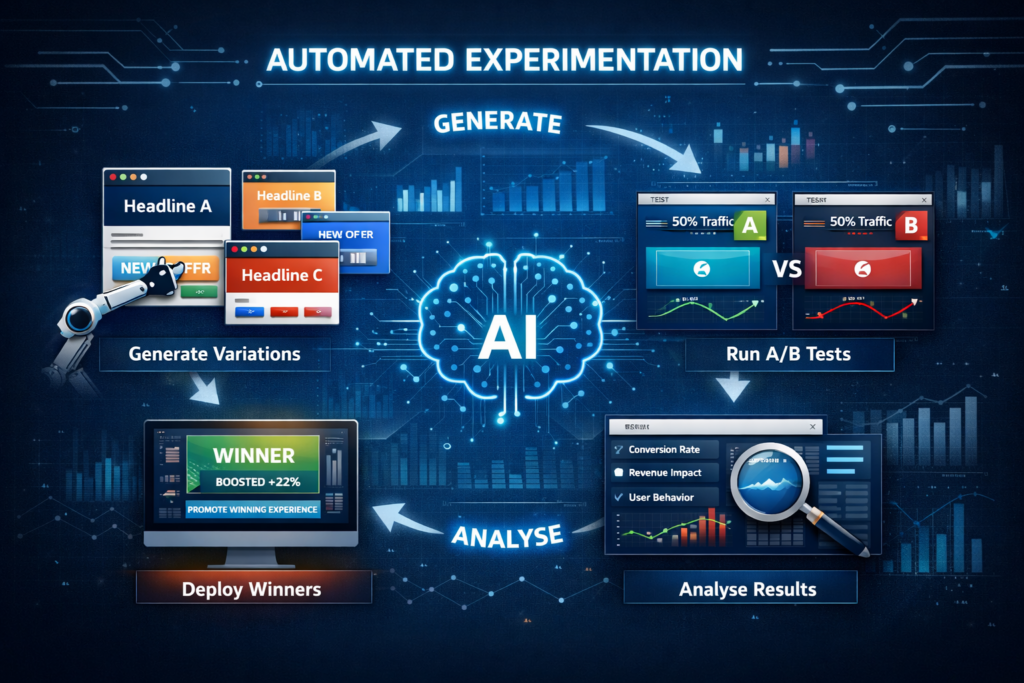
The interesting thing about experimentation is that it follows a pattern.
You form a hypothesis.
You test a variation.
You measure the outcome.
You deploy the winner.
Rinse. Repeat.
Once you recognise that pattern, it becomes obvious that much of it can be automated.
If an AI system (like Optimizely’s Opal) can generate content variations, launch experiments automatically, measure the outcomes, and promote the winning option, the entire optimisation loop can run continuously without human intervention.
This is not theoretical.
Large e-commerce platforms already rely heavily on automated recommendation systems. Amazon has stated that around 35 percent of its sales are driven by its recommendation engine. That engine is effectively making merchandising decisions at scale. It decides what product to show to whom and when.
No human team could make those decisions individually for millions of customers.
The machine does it.
The Economics of Automated Decisions
There is a simple economic reason this shift is happening.
Digital environments generate an extraordinary amount of data.
Every click, scroll, purchase, abandonment, and return generates a signal. For large platforms this means millions of behavioural events every hour. The raw material for optimisation is abundant.
The bottleneck is not data.
The bottleneck is decision making.
Human teams simply cannot evaluate that much information quickly enough to act on it. Even well-run organisations struggle to translate insight into action at speed.
AI changes that.
An algorithm can process thousands of signals simultaneously, test multiple possible responses, and deploy changes instantly. The difference in speed alone creates a competitive advantage.
McKinsey has estimated that companies that effectively use customer behavioural data outperform peers by as much as 85 percent in sales growth and more than 25 percent in gross margin.
Those gains do not come from dashboards. They come from acting on the data.
The Emergence of the Self-Optimising Website
Nowhere is this shift more visible than in digital experience platforms.
Traditionally, a website or mobile app was something a team designed and maintained. Updates happened occasionally. Campaigns were planned weeks or months in advance.
Increasingly, that model is breaking down.
Instead of static experiences, companies are building systems that continuously optimise themselves.
A modern digital platform might automatically adjust:
- the layout of a page
- the messaging shown to different audiences
- the products recommended to each visitor
- the timing and content of promotional offers
These decisions are driven by models trained on behavioural data.
The result is that two customers visiting the same website may see entirely different experiences, both optimised for the likelihood that they will convert.
This is not personalisation in the old sense of segmenting audiences into groups. It is closer to real-time adaptation.
Generative AI Accelerates the Process
Generative AI adds another interesting twist to the story.
Historically, experimentation programmes were constrained by the effort required to produce variations. Someone had to design the page, write the headline, and build the new experience.
With generative models, that constraint disappears.
AI can produce hundreds of headline variations, product descriptions, or promotional messages in seconds. Instead of testing five options, organisations can test fifty or five hundred.
The optimisation problem becomes a search across a vastly larger possibility space.
When experimentation engines, personalisation systems, and generative models are combined, you start to see the outlines of something new: a digital system that continuously generates, tests, and improves experiences without waiting for human input.
Management in an Algorithmic World
This raises an uncomfortable question for many organisations.
If machines are making operational decisions, what exactly are humans doing?
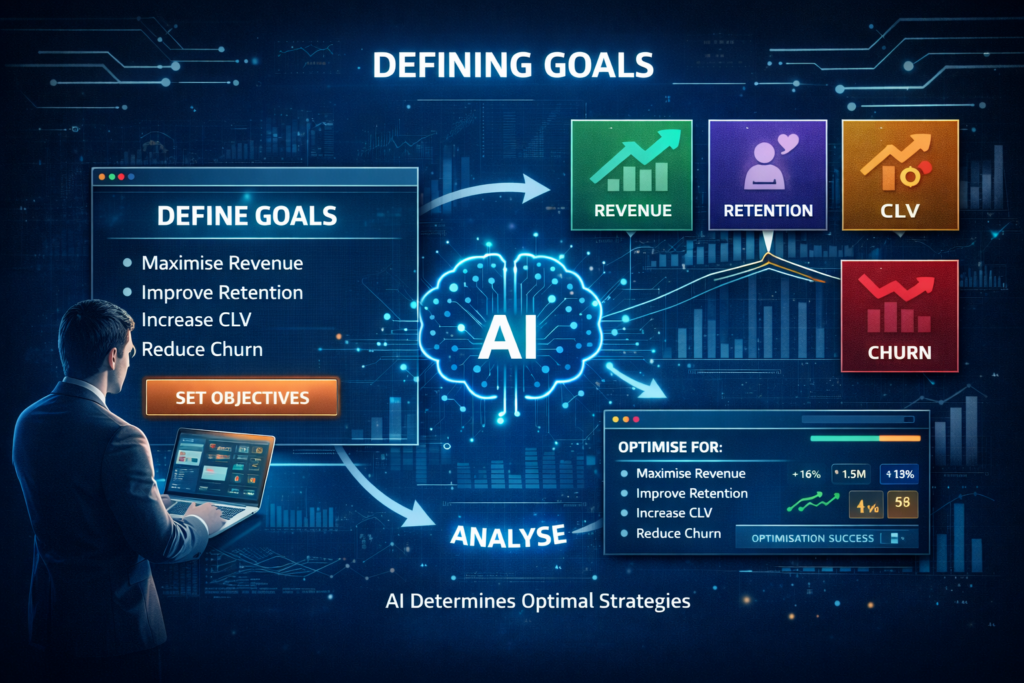
The answer is that the human role does not disappear, but it moves up a level.
Humans define the goals.
Maximise revenue per visitor.
Improve retention.
Increase lifetime customer value.
Reduce churn.
The AI system then explores how to achieve those goals within the constraints it has been given.
This is similar to how algorithmic trading works in financial markets. Traders no longer execute every trade manually. Instead, they design strategies and allow automated systems to execute them at scale.
The skill lies in designing the system rather than operating it.
Digital businesses are heading in the same direction.
The Risks Are Real
Of course, handing decisions to algorithms is not without risk.
The most obvious danger is optimising the wrong metric.
If an AI system is told to maximise short-term conversions, it may do so at the expense of long-term brand trust. Aggressive promotions might boost revenue today while damaging customer loyalty tomorrow.
Another risk is opacity.
Complex models can make decisions that are difficult to explain. This becomes problematic when those decisions affect pricing, promotions, or customer treatment.
And then there is the question of bias. AI systems trained on historical data may reproduce patterns that organisations would prefer to avoid.
These issues are not reasons to avoid automation altogether, but they do mean governance becomes essential.
The Quiet Transformation
Despite the headlines about generative AI, the most important transformation in business may happen quietly. (and is already happening!)
It will not arrive as a single moment or product launch. Instead, it will emerge gradually as more operational decisions move from humans to machines.
First it will be recommendations.
Then automated experiments.
Then fully autonomous optimisation loops.
Eventually the digital parts of the organisation will behave less like static systems and more like living organisms, constantly sensing their environment and adapting in response.
The companies that understand this shift early will build infrastructures designed for continuous learning. Those that do not may find themselves competing against organisations that improve faster simply because their decision systems operate at machine speed.
And when that happens, the real competitive advantage will no longer be the best idea in the room.
It will be the best system for discovering what works next.
Leave a Reply